Showing posts with label Tank Raised. Show all posts

Tuesday, June 1, 2010

New June '10 Releases from ORA: Blue Cespitularia and Blac Ice Semi-Snowflake

ORA has been very busy this year diversifying the lineup. While Clownfish are still the Hallmark fish of ORA, they are many new species in the works including Mandarins and Blue Assessors, as well as many other great captive raised fish and coral. This month they add another Designer Clownfish to the game, The Black Ice Semi-Snowflake Clown, a beautifully abberant cross bewteen a Black Ocellaris and Snowflake (which is also an Ocellaris variant, opposed to the Platinum, which stems from Picassso Percula genes.)
Here's what ORA had to say of their new release:
  • "ORA is introducing another new clownfish variety this month. The Black Ice Semi-Snowflake (Amphiprion ocellaris) was created by crossing a Black Ocellaris with a Snowflake. We were really hoping to get a Black Snowflake but wound up with an orange one with ultra intense black markings. These guys have yellow-orange bodies with an irregular white zig zag in the mid-section. The thick black outlines really make the colors pop."
Available for about 1/3 the price of a Snowflake clown in limited quantities, these are sure to go fast. I have several extremely aberrant ORA clowns in my store, and I have to say they might be more beautiful than their near albino brethren. The characteristic cheek spine or eye dots and jagged markings make them very unique.

ORA's new coral release for the month is the Blue Cespitularia. This is a very welcome coral to the industry as soft corals gain popularity again within display tanks. I have been farming a garden variety Cespitularia, and it has been quite popular as this coral is rarely available, even in normal colors. This variety is absolutely stunning and one can imagine how nice it must look under reef lighting or LEDs. Tyrpically soft corals with such vivid coloration require a good amount of supplemental feeding, but you can be assured this ORA piece is well adapted to tank life.
"ORA now offers a unique variety of Blue Cespitularia which has a sparkly turquoise body and peachy-orange polyps. This variety differs from the African variety which has a darker blue and purple coloration. It is rare to find such a bright and beautiful soft coral that is photosynthetic and so easy to care for.
Blue Cespitularia, sometimes referred to as “Blue Xenia”, is one of the most sought after soft corals in the industry. The color and movement of this coral appeals to all types of reefers, and its peaceful nature and hardiness make it an easy addition to any reef tank.
Blue Cespitularia adapts to a variety of lighting conditions, but we have noticed the most intense coloration under lower light levels when compared to typical SPS requirements. So as always, we suggest starting this coral out on the tank bottom and gradually moving it up to the desired location. Our other observations show that this coral prefers moderate to high water current and spreads by sending out a foot-like projection which attaches on to a nearby rock or solid surface."
These, as well well as all of the other ORA favorites can be found at The Mystic Reef.

Saturday, May 9, 2009

Responsible Reefkeeping: Sustainability

In a world where living green is on everyone's mind, how does it affect the reefkeeping hobby? When all of the planet's resources are in demand, how do we ensure the future of our hobby, when even the future of wild reefs is unknown?
It is a true fact that reefs all over the world are in decline, and it is very simple to point fingers at the aquarium industry, when in fact the true causes go far deeper that. Much of the destruction is caused by overfishing for the food industry, or by irresponsible divers, as well as pollution and of course rising ocean temperatures and elevated CO2 levels. Any aquarist using a calcium reactor knows that excess CO2 causes a drop in pH, creating a more acidic solution, to the point where it will dissolve reactor media (coral skeletons).
However, there are places in the world where conservation has come to the attention of the local communities, and those areas are showing great signs of resiliency.

Fish collected for the marine aquarium hobby earn local collectors on average 5 times as much as fish caught for food, making them far more profitable for local villagers in often third world countries.
Times have certainly changed in the past few years, to the point where owning a thriving reef aquarium is no longer the realm of public aquariums and a handful of private aquarists, but accessable to all ages and walks of life.

What can you do? Research; know what your getting involved with when you try to care for a new species
.

We all need to take heed from the freshwater side of the hobby, where in some places upwards of 90% of the fish are tank raised, we just need pioneering aquarist to unlock the secrets of their saltwater cousins, as well as the urging of hobbyiests for more tank raised fish.

Only through the support of the hobbyists will this ever become a reality. There are a number of farms raising various species of Clowns, Gobies, Pseudochromis, Cardinal fish and more, but if no one is willing to pay a few extra dollars for a fish that is a thousand fold more suited to tank life. The Bangaii cardinal is a perfect example, this fish has a VERY limited range in nature, and collection has pushed it the point that it in danger of becoming extinct (http://teacher.scholastic.com/scholasticnews/indepth/endangered_species/news/index.asp?article=reeffishguide). Several farms, such as O.R.A., have been successful in raising these fish for the trade, and farm raised should be the only option for this fish, especially considering the high mortality rate of these fish in transit.

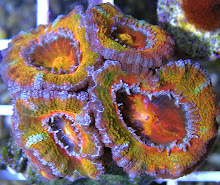
Corals have come a long way in the aquarium trade, and now almost any coral in any color can be found being tank raised somewhere. This is amazing considering just a short 15-20 years ago, it was considered impossilbe to keep most corals alive for more than a few weeks or months. We are at the point now where many events cater exclusivley to farm raised coral, such as the Coral Farmer's Market Events put on by Steve Tyree and ReefFarmers(http://www.coralfarmersmarket.com/ )

Tank raised corals and fish are much better suited to aquarium life than their wild cousins for countless reasons. The fish are already used to living in a glass box, and are usually eating readily available foods such as pellet or frozen. One of the biggest reasons is that they do not have to endure being in a small bag for 36-48 hours or more as well as the rest of the rigors of transit across oceans, which applies to both corals and fish.

Tank grown coral frags have a much better ability to adapt to various tank conditions opposed to a mature wild colony, as anyone whos ever purchased a beautifully colored colony only to have it turn brown or even die within a few days. Corals grow to adapt to the lighting and water flow conditions, which is very different on a natural reef exposed to intense sunlight and massive surge flows from wave action and currents than a tank with a few powerheads and some metal halide lights. A fragment will be able to grow those specific conditions present in a tank, to the point where tank grown corals are often indistinguishable from their wild counterparts.

Well, I feel like I've barely scratched the surface of this very broad topic, but there will be more soon to come. As my first post, I feel this is more of an overview while trying to cover various points. I will go into more detail on each point in subsequent posts.
All photos are of tank raised livestock, including the Snowflake and Picasso Clownfish from ORA farms.